Introductions Deconstructed (Rules and Exceptions) – Part 2: Names

The Rules
(And their Exceptions)
Part Two of Three Entries


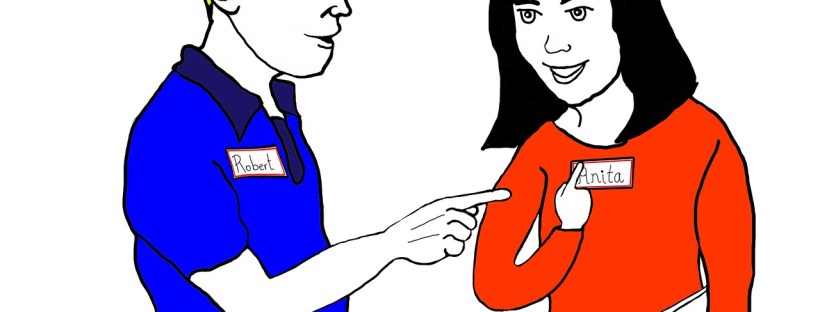
Welcome back!  In Part Two of "Introductions Deconstructed," we'll focus on the importance of names in making introductions.

Saying and Remembering Names

Everyone enjoys hearing her name.  Thus, it’s important to pronounce names clearly when making introductions.  Don’t hesitate to ask someone to pronounce his name again; people are happy to ensure that their names will be pronounced correctly and don’t mind repeating their names or hearing their names repeated by someone else.  Westerners frequently experience difficulty in pronouncing Asian, African and Middle Eastern names and vice versa.  As a result, people whose names are difficult to pronounce in the country in which they live often adopt a nickname that people in their adopted country can understand.  It is in line with the tenants of etiquette to make every effort to pronounce one’s native name, but if a person is comfortable with his nickname, it is acceptable to use it in everyday, informal, language.  I’ll address this topic with respect to correspondence and formal invitations in a future entry. 

The Perfect Handshake

It's Critical to Your Career!

Your job interview, prospective client, seat on a board or membership in an organization can be won or lost on the strength of your handshake. It can put you over the top or sink your chances. While this seemingly routine and innocuous little nicety lasts only a few seconds, it will be remembered forever.

The Eyes Have It

The “it” that eyes have is the ability to connect with people in a powerful way.  Former President Bill Clinton is well known for his ability to captivate an audience of one or one thousand by making and maintaining eye contact.  You, too, can learn how to achieve eye contact with others in a way that will make you memorable.

The Age of Chivalry, Etiquette & Valentine’s Day

Etiquette in the Western world is popularly believed to have its roots in The Age of Chivalry during the European Middle Ages (circa 1100 -1500 A.D.). Throughout this age, kings, queens and knights in shining armor created a code of behavior and ethics that has lasted in some form to modern times.

During this era, the modern concept of St. Valentine’s Day emerged. Although the day harbors a shadowy past stretching back many centuries--its roots buried deep in both paganism and Christianity--there is no doubt about the romance and chivalry that materialized around 1400 A.D., including the heart-shape as a symbol of romantic love and Chaucer's Parlement of Foules, connecting St. Valentine’s Day to romance.

Your Most Powerful Secret Weapon

 One of the most iconic symbols of our time is the Smiley Face. It’s been around since the 1960s with many variations, including the ones that people draw after their signatures or the ones in email emoticons to indicate that a statement is meant in a friendly manner. But why is it that so many people know to use Smiley to indicate kindness and friendliness in the written word, yet don’t use their natural smiles in person-to-person contact?

Brand Central

   Who are you?   Who do you want to be?


Question:  What do Apple, Starbucks, Facebook,  Amazon.com, Coke and Pepsi have in common?

Answer: They are all highly-recognizable, distinctive and wildly popular brands.

Question:  What do Nelson Mandela, Hillary Clinton, The Dali Llama, Justin Bieber and Santa Claus have in common?   

Answer:  They are all highly-recognizable, distinctive and wildly popular brands.

What comes to mind when you hear the word, “Apple”:  a sleek, highly efficient and very cool i-product?  Or when you think of American Eagle do you equate it with chic, up-to-the-minute fashion?   And, how about Coke, a product that’s been around a long time and has had generations to build its brand, employing a wide variety of images and messages?  See how this vintage Coke commercial from the 1970s featuring teen and 20-somethings makes you feel about Coke. 

Generations at Work

Much has been written and discussed regarding the generational differences in the workplace, so I thought it might be helpful to identify what have become the names and birth-year spans of the generations of the 20th- 21st Centuries.  Please keep in mind that those born close to the generations before or after their own will often share those respective characteristics, as defined by historians, marketers and various individuals throughout the years.  For example, a Gen Xer born in 1978 might exhibit many qualities of a Gen Yer. (Among experts there are also some variations in the year-spans of each generation.)

Bells Are Ringing

   And Not in a Good Way! 

Is there anyone left on the planet who doesn’t comprehend the crisis in civility that we’re facing with our mobile devices?  We’re in the midst of a PDA pandemic that has turned us into addicts.  And, just as we get our dependency on crackberries under control, Apple tempts us with its new iPhone. 

The paradox – and hypocrisy -- is that while most people are quick to criticize cell phone offenses, the same people also tend to be the offenders.  The good news is that mobile devices can make our lives easier, more productive and safer; the bad news is that can make our lives harder, less productive and more dangerous.

What Not To Say In 2012

Whatever.  Absolutely!  You know….like…just sayin’.

These top the list of the most annoying words that litter our conversations, according to a Marist Poll published last month.  Students at Michigan's Lake Superior State University also published their annual New Year’s Eve List of the most overused words.

Several such lists are published every year, yet we continue to hear – as well as use -- these utterances daily.  The latest polls and surveys, however, should serve as a reminder that we need to concentrate on purging these shopworn words from our vocabularies.   And, most of us are guilty of using them to some degree.