Dining Etiquette Series – Using Your Knife and Fork

“No one's gloomy or complaining
While the flatware's entertaining…”

~ “Be Our Guest,” sung by Lumiere, from Beauty and the Beast

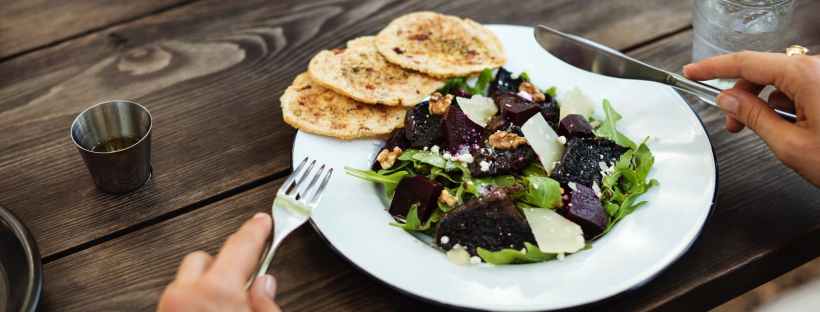
Lumiere is correct. Your flatware can be entertaining if you have to stop and figure out what it all means, and how to use it! But, Lumiere and I have you covered. Before you read on, you might want to review my introduction to using flatware in a previous post, under the heading, “Flatware.”   

In this entry, let’s take a look at the two main styles of using one’s knife and fork, The American style and The Continental style. The American style is so named because it is usually only Americans and perhaps some Canadians who use it, while the rest of the world uses the Continental style. And, it’s fun to speculate on the reasons for the different styles. 

Dining Etiquette Series – The Tablecloth

A good upbringing means not that you won't spill sauce on the tablecloth,
 but that you won't notice it when someone else does.
~ Anton Pavlovich Chekhov (1860–1904), Russian author, playwright

Yes, there’s even etiquette and protocol with regard to the tablecloth! According to Suzanne von Drachenfels in her book, The Art of the Table, “the tablecloth was the first decorative accessory known to the table…” 

Whether dining out, as a guest in someone’s home or when selecting a tablecloth for use in your own home, it’s helpful to know some tips about tablecloths. 

Dining Etiquette Series – Crystal Gazing

Question: What did the women of Sex And The City not know how to do
that Bogart and Bergman finally got right in Casablanca


Answer: The correct way to hold stemware! In a number of scenes throughout the series, the sophisticated ladies of Sex and the City are seen holding their wine or champagne glasses incorrectly--by the bowl instead of the stem. And, although Bogie and Bergman fumbled their goblets, as well, in Casablanca, they finally got it right in the scene where they are together for the last time in Paris. Toasting each other with champagne and holding their glasses correctly by the stems, Bogie utters one of his most famous lines: “Here’s looking at you, kid.” 

Dining Etiquette Series – The Salad Plate

"There was an Old Person of Fife,
Who was greatly disgusted with life;
They sang him a ballad,
and fed him on salad,
Which cured that Old Person of Fife."

~ Edward Lear, English artist, writer (1812-1888)

Ah, the salad course! It’s my favorite, and, as an American, I prefer to enjoy it before the main course. But, in some countries, especially in Europe, the salad course is served after the main course as a palette cleanser before the cheese course is served.

It is believed that as far back as ancient times, the Romans and Greeks dined on raw vegetables that they dressed with vinegar, oil, and herbs. And, according to the Oxford Companion to Food, the word, “salad” resulted from the progression of first the Latin word, sal, which means “salt”; later the form, salata, which means, “'salted things” referring to a primary ingredient of dressing they used; and then the Old French word, salade; and finally in 14th century emerged the English word, “salad” or sallet, as they said back then.

Dining Etiquette Series – The Bread and Butter Plate

Show That You’re Well-Bred When Breaking Bread

The formal table setting often includes the bread and butter plate, which is located at the upper left of your service or main plate, directly above your forks. However, on a crowded table this small plate might be placed wherever there is room, but always to the left. On your B&B plate will rest a butter spreader, named such because it’s used to spread butter rather than to cut bread. (See the section below, Buttering Up, regarding missing butter spreaders).

To remember that your B&B (as well as your salad) plate is placed to the left of your main plate, and glasses are placed to the right, try these methods:

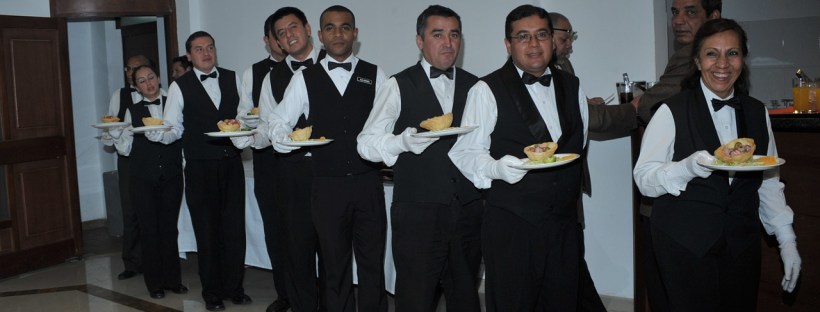
Dining Etiquette Series – The Wait Staff

“It's hard to get a dozen CEOs to agree about anything, but all interviewed agree with the Waiter Rule…How others treat the CEO says nothing, they say. But how others treat the waiter is like a magical window into the soul.” ~ USA Today

Whether you’re the host or guest at a business or social function at a restaurant, corporate dining room, banquet hall or your own home, your strongest partnership in such an endeavor will be with the wait staff. As the quote above attests, you’ll be judged by the way you relate to and treat the wait staff.

Dining Etiquette Series – The Power of the Early Arrival

Ford: …better three hours too soon than a minute too late.
 ~ William Shakespeare, The Merry Wives of Windsor, Act 2, Scene 2

“I must have missed it,” said Dumbledore cheerfully. “However, due to a lucky mistake, I arrived at the Ministry three hours early...”
 ~J.K. Rowling, Harry Potter and the Order of the Phoenix, Chapter Eight, The Hearing  

Both Windsor citizen Ford and Hogwarts’ Professor Dumbledore knew that by arriving early they could accomplish their goals. Three hours might seem to be a bit of an early lead, but I think we’d all agree that it depends on the mission.

The Formal  Affair

If you are invited to a State Dinner at the White House, a charity ball, corporate black-tie dinner, a wedding or similar formal affair, punctuality is crucial. For some occasions, you may receive instructions on the suggested arrival time. In any case, it is advisable to arrive no later than 20 minutes prior to the time indicated on the invitation, and I advise to arrive 30-40 minutes ahead of time, because:

Dining Etiquette Series – The Pleasure of Your Company is Requested

Nothing annoys people so much as not receiving invitations.”
― Oscar Wilde, The Importance of Being Earnest

Dr. Carolyn and Mr. Warren Nelson
Request the Pleasure of Your Company
On the Twentieth Day of June
At 8:00 O’clock in the Evening
At Their Residence
To Celebrate the Occasion of Their
Twenty-Fifth Wedding Anniversary
Black Tie Optional
R.s.v.p.

Whether the invitation is formally engraved in calligraphy or spoken casually in passing, the invitation to break bread is the first step in the dining etiquette process, whether the occasion is a formal dinner, buffet supper or back yard barbeque.  Following are the types of invitations you might receive, the guidelines for responding, and descriptions of the dress codes that are often included with invitations.

A New Year – A New Start – Dining Etiquette Series

New Year’s Resolution: Perfect Your Dining Etiquette

To start out the New Year, in a series of posts I’ll be addressing a subject that is essential to the success of every professional – dining etiquette.  In fact, this is such an important topic and of great interest to students and young professionals that in 2013 I will be concentrating on this topic, as well as networking techniques, in my PROWESS Workshops