“I’ve had my fair share of colds, which last longer than they should and can cause wheezing, so I avoid people who are sneezing like the plague and am scrupulous about hygiene and hand-washing.” ~ Kevin McCloud
“I have caught more ills from people sneezing over me and giving me virus infections than from kissing dogs.” ~ Barbara Woodhouse
“Coughs and Sneezes Spread Diseases” ~ Slogan coined in the U.S. during the Spanish Flu Pandemic (1918-1920)
Did you know that according to the National Institutes of Health a typical sneeze can act like “a turbulent jet and travel up to 25 ft in nearly 22 s. (seconds)” as it showers everything in its path, potentially including you?
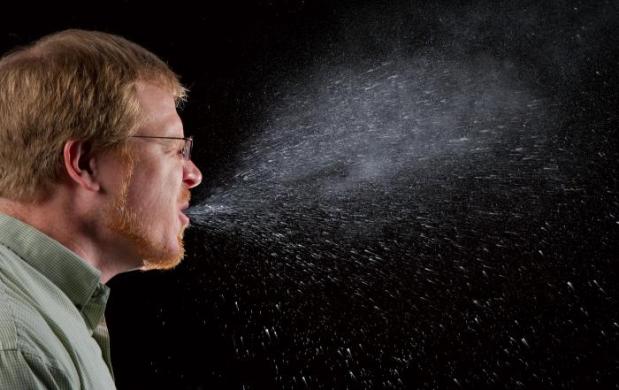
The photo above, taken by James Gathany and courtesy of the CDC, captured a sneeze in progress. As you can see, the sneeze is forcefully expelling respiratory droplets through the man’s mouth. Such droplets might contain an array of germs that upon making contact could infect others with an alarming number of diseases, including the common cold, the seasonal flu, COVID 19, RSV, whooping cough, measles, mumps, chickenpox, polio and meningitis! These droplets fall on tables, desks, papers, pens and pencils, portfolio covers, cell phones, handbags, lunchboxes, backpacks, books, eyeglasses, etc., and can live for hours on these various surfaces, as people innocently touch them repeatedly. Coughs can do similar damage.
This is especially noteworthy because we are currently in the midst of what seems to be a particularly rough winter cold and flu season. combined with the rise in cases of COVID and RSV, the latter of which affects babies, the elderly and those who are immunocompromised. Anyone coming down with one or more of these viruses — separately or together — often suffer long-lasting discomfort and disruptions.
“It’s a perfect storm of all three viruses circulating,” said Dr. Sandra Adamson Fryhofer, a board-certified physician of internal medicine and past president of the American Medical Association’s board of trustees in this article. Dr. Fryhofer also pointed out that the seasons for RSV vary each year, and last month this year’s RSV season converged with the cold and flu season. “And that was terrible,” she said.
On May 5, 2023, The United Nations declared on its website, “The head of the UN World Health Organization (WHO) has declared “with great hope” an end to COVID-19 as a public health emergency, stressing that it does not mean the disease is no longer a global threat.” With that statement, COVID-19 officially went from being a pandemic to being endemic. Since then, people increasingly have been spending more time onsite at their workplaces, students have returned to campuses, and children and teens are back in classrooms.
So, as people gather in conference rooms, auditoriums, theatres, lecture halls, classrooms and the like, it pays to be aware that one sneeze could wipe out a conference room, lecture hall or classroom for days or weeks! Multiply that by the number of sneezes that occur everywhere, every day and we can see how powerful and destructive a sneeze can be!
Gesundheit!
To avoid or reduce the suffering that we and our families experience from these infections, the loss of time and productivity in our professional and academic lives, and the disruption to our personal plans, and to be considerate and respectful towards others, now is a good time to review the steps we can take to prevent and deal with these viruses:
Needling – First and foremost, get vaccinated. Healthcare professionals strongly advise this, including those at the WHO, the CDC and the AMA. Vaccines for the seasonal flu, COVID and RSV are available at many pharmacies across the country. COVID vaccinations are free to patients in the U.S., and are covered under Medicare, Medicaid, most private insurance policies (the ACA allows coverage for people up to age 26 on their parents’ policies), and the CDC’s Bridge Access Program. Uninsured children may be covered under the VFC or CHIP programs. For flu and COVID vaccinations in your area, check with your insurance or healthcare provider or local health department, or try this nationwide vaccine finder website: VaxAssist. For RSV vaccinations, check with your provider, local pharmacies or health department. As well, keep all other vaccinations up to date. Note: For those who don’t like needles, check with your doctor or pharmacy about the nasal flu vaccine. For the next flu season at the end of this year, it is expected that people will be able to administer FluMist by AstraZeneca to themselves – wow! Approvals, coverage and other details need to be worked out, but this could be a game changer in drastically reducing cases of the season flu. It would be lovely if we could also have such self-administered nasal vaccines for COVID and RSV. We’ll see.
Test, and Test Again – Free COVID antigen test kits are back; go to this FTC website for information on how to get yours. Take advantage of these free test kits so that if you are knowingly exposed to someone who is positive for COVID, or if you have symptoms, you can test yourself. COVID is treated differently than other viruses, so it is important to know what you have in order to treat it properly. It is recommended that if you test negative for COVID, repeat the test 48 hours after your first test. If you test positive, or as an alternative to repeating the home test, you should get a PCR (Polymerase Chain Reaction) test, which is considered by health professionals to be the gold standard of COVID testing, at a facility that performs these tests. These often include urgent-care facilities, but you can check with your local health department for information. To avoid testing delays, I advise ordering your antigen home tests and locating a facility that does PCR testing as soon as possible so they are available if and when you need them.
WFH – If you feel yourself coming down with something or suddenly feel ill, it is wise to stay home and spare your coworkers, classmates, clients, and others from catching what you have. Traditional COVID protocols are still in place and are similar to those for the flu — for both the recommendation is to isolate for five days before venturing out or returning to work, and then wear a mask until you are completely well again. And, if you feel well enough to get some work done, working from home will help you keep on top of things. With more employers allowing work-from-home schedules, loss of productivity can be kept to a minimum and employees can feel less pressured to go to the office when they are ill. But even when working from home, observe best practices to keep yourself and your family safe and healthy.
Masking the Situation – Mask wearing is still a thing, so whether or not you are vaccinated I highly recommend wearing one in certain circumstances, such as a conference room, auditorium, lecture hall, classroom, factory, courtroom, voting facility, theatre, big box/department/grocery stores and any other indoor, crowded place. And if you don’t want to wear those fashion masks you bought that were popular during the pandemic, there are many fun and attractive disposable masks that you can wear to express your personality while helping to protect yourself and others. Keep your masks clean, and care for both disposables and reusables as recommended by the manufacturers or the CDC. Also remember that a mask still offers some protection to you and those around you even if you are the only one wearing one.
Covering Up – As we’ve seen from the photo, it’s a wise move to cover our noses and mouths when sneezing or coughing. Sometimes a sneeze or a cough comes up suddenly when you don’t feel ill. The proper way to sneeze or cough is to do so into a tissue, or failing that, into the crook of your arm (be sure to launder or dry clean your shirt, blouse or jacket afterward). If the sneeze or cough comes up too fast to use either of those methods, cover your nose or mouth with your hand(s), and then clean your hands immediately with a tissue or hand wipe, then a hand sanitizer. No one is going to want to shake hands with you until you do!
If you are having a sneezing or coughing fit, excuse yourself and go to the loo or somewhere where you can get yourself under control and clean up, and return as soon as possible, without fanfare. Likewise, should you have to sneeze or cough while dining with others, etiquette dictates that you do not do so into your napkin. Sometimes, however, that cannot be avoided. If that occurs, do not then proceed to blow your nose or continue to cough into the napkin, whether it is cloth or paper, as it is a very bad look and you might find that people are slowly distancing themselves, literally as well as figuratively. If you have to blow your nose or get your cough under control, excuse yourself and leave the table. Because it is considered rude to keep your dining companions waiting, return to the table as soon as possible, discreetly. (Note: For more on napkin etiquette, check out my post on the subject.)
One more thought on germ spreading: While sneezing and coughing have been proved to be the primary way germs are spread, scientists are studying and debating whether they can also be spread by laughing, singing, yelling or simply by talking and breathing. To mitigate those possibilities, masks and frequent hand and face washing can be helpful.
Handy Advice – While the frequency and correctness of handwashing increased during the height of the pandemic, we’ve fallen off somewhat post-pandemic. Women have outperformed men (as they have historically) but could also use some improvement. So, as a refresher, here is a tutorial on how to properly wash one’s hands: Keeping Hands Clean. According to healthcare organizations, handwashing actually saves lives! Also keep in mind that hand sanitizers are quick fixes and do not replace hand washing (note that there are many hand-sanitizers with light pleasant fragrances so we don’t need to only use those that have strong medicinal scents – just be sure they contain at least 60% alcohol). As well, using a hand wipe until you can do a proper hand washing is fine, as well; there are many, some are anti-bacterial or contain alcohol, but I like the plain ones as a stop-gap until I can wash my hands. Finally, use a good hand lotion after washing to keep your hands from drying out, especially in winter.
Face Facts
Remember during the pandemic when we were told to stop touching our faces to avoid spreading COVID germs that might be on our hands? We were shocked to learn how many times each day we touch our faces, and that doing so deposits germs that can also spread infections such as colds, flu, RSV, pink eye and other unpleasant conditions. There are some reasons we must touch our faces, however, and we should do so with clean hands or a tissue, including to wash; shave; apply moisturizer, medication or makeup; pluck eyebrows or brush foreign objects from our faces, for a few examples. Otherwise, it’s hands off!
Surfacing the Problem
Tables, chairs, desks, doorknobs and other surfaces we touch regularly can be covered with droplets from recent sneezes or coughs. To be thorough in protecting yourself and others, frequently wipe such surfaces with a disinfectant wipe such as Lysol, Seventh Generation, or a store brand that says on its label that it kills cold, flu and the COVID-19 viruses. You might also want to put on a protective plastic or rubber glove to protect your hands from the chemicals in the wipes.
Don’t Forget the Kids
Start your kids off right by teaching them proper hygiene at a young age. I think this might be a fun, if not slightly messy, way to teach them about sneezing: Glitter Germ Lesson; if you prefer to use something other than glitter to illustrate the point, confetti might work almost as well. It’s up to parents and teachers how to instruct children about sneezing and coughing, and such lessons could serve them well for their whole lives. And that’s nothing to sneeze at!
Until next time,
Jeanne
Note: While I am offering suggestions and opinions, I am not recommending any of the websites for which I have provided links; they are merely for information only. Readers should always conduct their own research and reach their own decisions.
 Jeanne Nelson